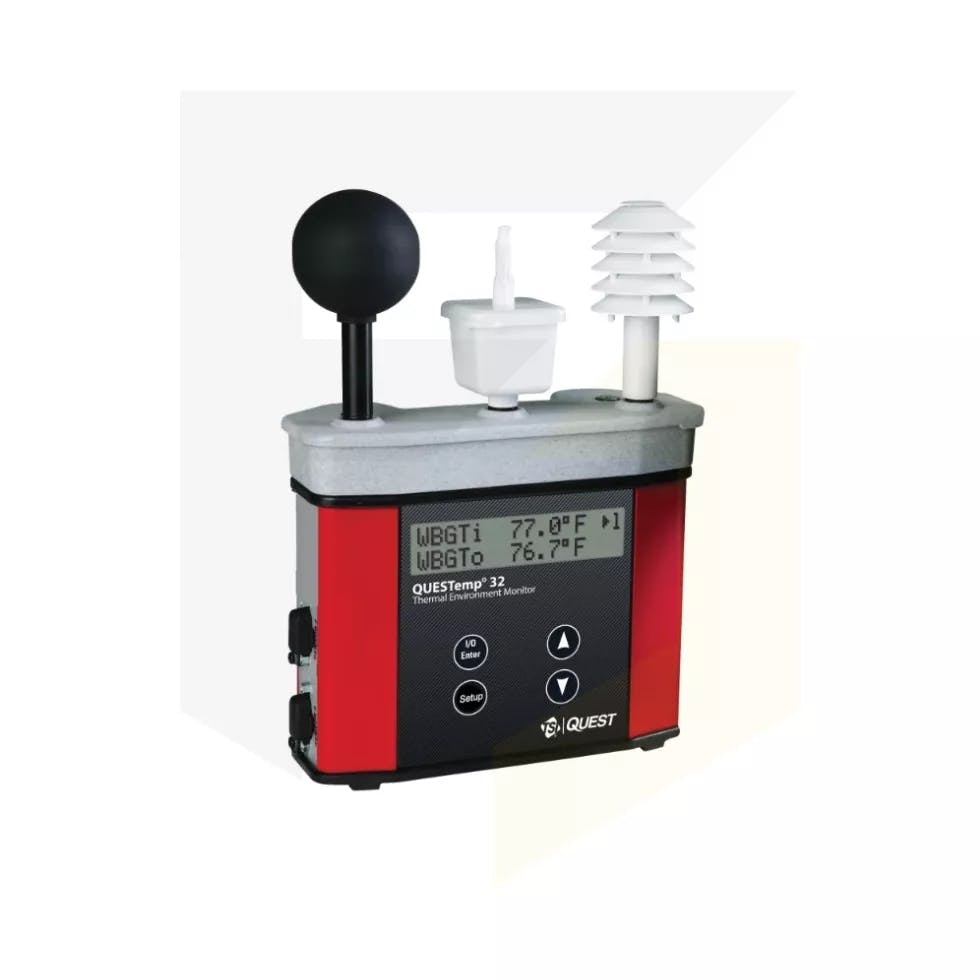
The QUESTemp 32 is trusted by safety professionals worldwide for its accuracy, durability, and ease of use. Whether you’re ensuring compliance with heat stress regulations or protecting workers from heat-related illnesses, this monitor delivers reliable, real-time data when it matters most.
TSI QUESTemp 32 Heat Stress Monitor – Workplace Heat SafetyProtect your workforce with precise heat stress monitoring. The TSI QUESTemp 32 is a rugged, IP54-rated instrument designed to measure heat stress risks in industrial, military, and environmental applications. Using Wet Bulb Globe Temperature (WBGT) analysis, it provides accurate real-time data to help prevent heat-related illnesses and ensure compliance with safety regulations.
This field-ready heat stress monitor measures Dry Bulb, Wet Bulb, and Globe Temperatures. It also has a built-in Relative Humidity (RH) sensor for complete environmental assessment. The QT-32 calculates both indoor (WBGTi) and outdoor (WBGTo) WBGT values, helping you assess heat risk levels in different conditions. It is available with either a 2-inch or 6-inch black globe sensor, meeting BS EN 27243 standards for occupational safety.
With multiple power options, it operates on a 9V disposable battery (140-hour runtime), an optional NiMH rechargeable battery (300-hour runtime), or mains power for 24/7 monitoring. The optional tri-sensor plug-in assemblies allow for Head-Torso-Ankle WBGT weighting or multi-location monitoring, giving you advanced heat stress analysis in high-risk workplaces.
Who Should Use the TSI QUESTemp 32?
Industrial & Manufacturing Workplaces – Prevent heat stress in factories, foundries, and warehouses
Military & Emergency Response Teams – Monitor heat risk during training, operations, and field exercises
Construction & Outdoor Work Sites – Protect workers in hot and humid environments
Energy & Utilities Sector – Ensure safety in power plants, refineries, and mining operations
Environmental & Occupational Health Monitoring – Improve workplace safety and comply with regulations
Measurement Parameters
Dry Bulb, Wet Bulb, and Globe Temperatures
Relative Humidity (RH)
WBGT (Indoor & Outdoor) Index
Heat Index / HUMIDEX
Temperature Reading: Celsius or Fahrenheit
Data Logging Intervals: 1, 2, 5, 10, 15, 30, or 60 minutes